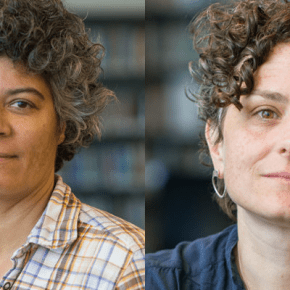
Editors’ Note: The following is an interview between HistPhil co-editor Maribel Morey and Hewlett Foundation President Larry Kramer, which took place over email in the past weeks. For earlier Q&As between Kramer and Morey, please follow this link. Below, Kramer discusses the foundation’s forthcoming plans to establish formal archives and the organization’s use of its history in its decision-making … Continue reading
Author Archives: HistPhil
“We will ‘Totally Destroy’ the Johnson Amendment”
Editors’ Note: During a speech at the 64th annual National Prayer Breakfast in Washington last week, Donald Trump reaffirmed his campaign promise to “get rid of and totally destroy the Johnson Amendment.” Here, Winnifred Fallers Sullivan offers a history of the amendment and some analysis on its likely future. President Trump announced at the National Prayer Breakfast on Thursday … Continue reading
The Atlantic Philanthropies and its Archives: Limited Life, Enduring Legacy
Editors’ Note: Joanne Volpe Florino continues HistPhil’s forum on archives and knowledge management with a post detailing the archival strategy of The Atlantic Philanthropies. This past December, The Atlantic Philanthropies made its final awards, becoming the largest limited life philanthropy to complete its grantmaking. The end of this aspect of its organizational life has been long-planned … Continue reading
Philanthropic Data and the Rise of LLCs; Or, What Happens when Scholars Can No Longer Follow the Money
Editors’ Note: education scholar Sarah Reckhow continues HistPhil‘s forum on archives and knowledge management. Her post examines how new institutional forms within the sector are reshaping and constraining philanthropic research, and what this might mean for the philanthropy archives of the future. The Chan Zuckerberg Initiative (CZI) has received substantial media attention and scrutiny during … Continue reading
Ford’s Darren Walker on How Philanthropy Can Mine its Own Past
Editors’ Note: The following is an edited transcript of an interview between HistPhil co-editor Benjamin Soskis and Ford Foundation president Darren Walker. In 2011, the Ford Foundation moved its archives, which had previously been housed in its New York headquarters, to the Rockefeller Archive Center (RAC). Two years later, Walker became president of the Foundation. Since … Continue reading
Foundation Archives in the Digital Age
Editors’ Note: Lucy Bernholz continues HistPhil‘s forum on archives and knowledge management. Foundations and archives often share a structural commitment to perpetuity. Yet most foundations haven’t shown an interest in organizing their own archives or in making them available to future scholars. This is a missed opportunity for institutions that care about their long-term impact. … Continue reading
The Beginnings of Independent Sector and Why They Matter
Editors’ Note: Last Week, Pablo Eisenberg, for decades one of the nation’s leading progressive critics of foundations, wrote an important op-ed in the Chronicle of Philanthropy calling for six reforms necessary to strengthen the nonprofit sector in the Trump era. One of those involved changes to Independent Sector, transforming it into “a new powerful coalition solely of charities.” In making … Continue reading
Bridging the Divide Between Scholarship and Practice: A View from the Rockefeller Archive Center
Editors’ Note: Laura Miller and Rachel Wimpee, historians and project directors at the Rockefeller Archive Center (RAC), continue HistPhil‘s forum on archives and knowledge management. The RAC is the nation’s leading repository of philanthropic archives, holding the records of such important institutions as the Rockefeller, Ford, and Russell Sage Foundations, as well as numerous nonprofits … Continue reading
Social Change & the Critical Importance of Open Archiving
Editors’ Note: This post, from Lisa Brooks and Gabriela Fitz at IssueLab, opens HistPhil’s forum on philanthropy, archives, and knowledge management. IssueLab is a searchable, browseable knowledge sharing platform that collects, curates, and distributes the social sector’s knowledge. IssueLab also supports ongoing learning and research in the sector, believing in the power of the sector’s collective … Continue reading
Introducing HistPhil’s Forum on Archives and Knowledge Management
This week, HistPhil begins a new forum on philanthropy, archives, and knowledge management. In some respects, the forum will likely cover ground already tilled by the many debates surrounding the issues of accountability and transparency occurring now within the sector. This forum, like those other discussions, will address the extent to which philanthropy opens itself … Continue reading
A History of Unequal Partnerships between American Foundations and African Universities
Editors’ Note: Fabrice Jaumont contributes a post based on his new book, Unequal Partners: American Foundations and Higher Education Development in Africa (Palgrave-MacMillan, 2016). At a time when higher education is once again recognized as a driver of development and income growth, when knowledge economies requiring additional levels of education are displacing economies predicated on manufacturing, … Continue reading
Morey on Willoughby-Herard’s WASTE OF A WHITE SKIN (2015)
Editors’ Note: HistPhil’s Maribel Morey reviews Tiffany Willoughby-Herard’s new book, Waste of a White Skin: The Carnegie Corporation and the Racial Logic of White Vulnerability (University of California Press, 2015). In a 1914 editorial titled “World War and the Color Line,” African American historian W.E.B. Du Bois explained to Black readers of the NAACP’s Crisis why they should … Continue reading
Joan Kroc’s Radical and Ecstatic Philanthropy
Editors’ Note: Journalist Lisa Napoli, who has recently published the first biography of McDonald’s heiress Joan Kroc, offers a fascinating portrait of Kroc’s philanthropy. Kroc is a figure who defies easy categorization. She was, in one sense, a traditional funder; one of her largest gifts was to a social service organization, the Salvation Army. But she also … Continue reading
The U.S. Fiscal State and the History of American Philanthropy
Editors’ Note: We’ve been on a brief hiatus while working on some history of philanthropy manuscripts, and at the same time, internalizing the U.S. presidential election results. On the latter topic, fellow HistPhil co-editor Benjamin Soskis published a piece for The Chronicle of Philanthropy earlier this month. Two weeks ago at ARNOVA, I presented some initial thoughts on philanthropy, American race … Continue reading
Disruptive philanthropy?
Editors’ Note: For this current forum, we have asked the authors of the recently-published volume Philanthropy in Democratic Societies to present synopses of their contributions. Here, Aaron Horvath discusses his chapter on disruptive democracy, which he co-authored with Walter W. Powell. In a June 2015 Wall Street Journal editorial, Sean Parker, of Napster and Facebook fame, advanced a manifesto for the new … Continue reading
Why is the History of Philanthropy not a Part of American History?
Editors’ Note: We have asked the authors of the recently-published volume Philanthropy in Democratic Societies to present synopses of their contributions. Continuing this forum, Olivier Zunz discusses his chapter on the historical study of philanthropy. If philanthropy were only an activity of the very wealthy, then the historical inquiry could safely center on the democratic legitimacy of large donations. But the debate … Continue reading
Designing nonprofits for the digital age: Lessons from the Digital Public Library of America
Editors’ Note: For this current forum, we have asked the authors of the recently-published volume Philanthropy in Democratic Societies to present synopses of their contributions. Here, Lucy Bernholz discusses her chapter on the Digital Public Library of America (DPLA). The story of the Digital Public Library of America (DPLA) fits into the volume, Philanthropy in Democratic Societies, as an illustrative case on the … Continue reading
Reconciling Corporate Social Responsibility And Profitability: Guidelines for the Conscientious Manager
Editors’ Note: In our efforts to introduce readers to new works in the field, we have invited the authors of the recently-published volume Philanthropy in Democratic Societies to present synopses of their contributions. Paul Brest continues this forum by discussing his chapter on reconciling corporate social responsibility and profitability. How can a company’s managers safeguard the firm’s financial value for its shareholders … Continue reading
The Problem With Discretionary Philanthropy
Editors’ Note: Since our last conversation on philanthropy and the state, we have been working on two other forums for the site. Highlighting new scholarship in the field, this next forum centers on the edited volume, Philanthropy in Democratic Societies (U. of Chicago Press, 2016). In the book, editors Rob Reich, Chiara Cordelli, and Lucy Bernholz have brought together an interdisciplinary community … Continue reading
New HULA Research on Humanities Grant Applications
Editors’ Note: Below, Christopher Pupik Dean, Maggie Schein, Sheena Kang, and Danielle Allen describe their research on grant applications funded by Illinois Humanities, with emphasis on its relevance for philanthropy scholars and philanthropists alike. The Humanities and Liberal Arts Assessment (HULA) project (a research and consulting group led by Danielle Allen and based out of … Continue reading