Editors’ Note: HistPhil co-editor Benjamin Soskis reviews Tyler O’Neil’s The Woketopus: The Dark Money Cabal Manipulating the Federal Government (Bombardier Books, 2025). I first heard about Tyler O’Neil’s The Woketopus: The Dark Money Cabal Manipulating the Federal Government because of a small online controversy over its cover. It shows the tentacles of a giant … Continue reading
Author Archives: HistPhil
How Informal Rules Are Used to Control Civil Society in Democracies: Lessons, and Warnings, from Hungary, Bulgaria, and the Czech Republic
Editors’ Note: Merrill Sovner adapts a 2019 report she co-wrote to address a particular timely question: how informal rules can be used to constrict civil society, focused on the examples of Hungary, Bulgaria, and the Czech Republic. In the current political moment in the United States, comparisons have been made to Viktor Orbán’s Hungary, both … Continue reading
Rothbard vs. Cornuelle: Understanding the New Right’s Antipathy toward Civil Society
Editors’ Note: John Miles Branch explores the feud between two prominent mid-century libertarian thinkers, Murray Rothbard and Richard Cornuelle, as a way of understanding the contemporary right’s growing antipathy toward nonprofits writ large. On February 6, the White House published a memo entitled “Advancing United States Interests When Funding Nongovernmental Organizations” that directs agency heads … Continue reading
Consulting to Nonprofits: A Field in Transition
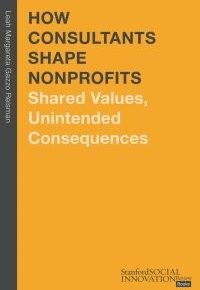
Editors’ Note: Leah Reisman introduces some of the major themes from her new book, How Consultants Shape Nonprofits (Stanford University Press/ SSIR Books, 2024). Consultants are everywhere in the nonprofit sector. Ranging from multinational organizations like the Bridgespan Group to tiny single-person shops, nonprofits and philanthropic foundations of all kinds hire consultants to solve organizational … Continue reading
Progressive Philanthropy and “The Groups” Critique
Editors’ Note: HistPhil co-editor Benjamin Soskis examines the place of philanthropy within the recently surging critique of “The Groups,” the term applied collectively to progressive advocacy organizations, which some have blamed for the Democrats’ November defeat. In weeks after November 5th, amidst the maelstrom of election post-mortems, an interview that journalist Ezra Klein conducted with … Continue reading
A “towering figure” in the world of philanthropy: Remembering Joel Fleishman
Editors’ Note: Damon Circosta and Kristin A. Goss celebrate the philanthropic legacy of Joel Fleishman, their colleague at Duke University’s Sanford School of Public Policy, who passed away on September 30, 2024. Photo credit: Chris Hildreth for Duke University. Joel Lawrence Fleishman, a towering figure in the world of philanthropy, public policy, and higher education, … Continue reading
Legal Personhood and the Social Responsibility of Business: A Review of Williams’ Taming the Octopus
Editors’ Note: Jared Berkowitz reviews Kyle Edward Williams’ Taming the Octopus: The Long Battle for the Soul of the Corporation (Norton, 2024). Few issues unify Americans like the problem of corporate power. Those on the right rally against the “ideological agenda” of “woke” capital—corporations led by social justice crusaders masquerading as CEOs. Others, on the … Continue reading
The Enduring Political Strength of Nonprofits: A Response to Kuttner
Editors’ Note: Jeffrey Berry responds to a recent article by Robert Kuttner in the American Prospect, “The Left’s Fragile Foundations,” by arguing that, in many ways, those foundations are more secure than contemporary alarms would suggest. We live in such a polarized and partisan era, that it is easy to overlook the distinctive political role … Continue reading
Bednets, Communion Plates, Scraps of Paper: Telling Stories About the History of Philanthropy Through Objects
Editors’ Note: Amanda Moniz introduces a recent special issue of The Public Historian, which she guest-edited, exploring material culture as a methodology for the history of philanthropy. What are your storytelling goals?, a thoughtful philanthropy professional asked not long ago. I’ve been asked versions of that question repeatedly since joining the staff of the Smithsonian’s … Continue reading
The General Purpose Foundation as a Mode of Capital
Editors’ Note: Sam Gill provides an outline of a new theory of the general purpose foundation, adapted from a recently published article in The Foundation Review, “Why Foundations? The Theory and Strategy of the General-Purpose Foundation.” Much of the important theorizing about general-purpose foundations over the history of this strange animal in the American institutional … Continue reading
Crowded Out: The Dark Side of Crowdfunding Healthcare and its Historical Precedents
Editors’ Note: The following is excerpted, with minor adaptations, from Crowded Out: The True Costs of Crowdfunding Healthcare by Nora Kenworthy. Reprinted with permission from The MIT Press. Copyright © 2024. When users consider starting a GoFundMe campaign, they are bombarded by messages of opportunity. The company has good reason to present crowdfunding as a marketplace of … Continue reading
Call for Contributors for six-volume History of Philanthropy (Bloomsbury)
Editors’ Note: We pass along this call for contributors to a six-volume History of Philanthropy, to be published with Bloomsbury Press in March 2028, and edited by HistPhil contributor Thomas Adam. Call for Contributors for six-volume History of Philanthropy to be edited by Thomas Adam and published with Bloomsbury Press in March 2028 We are … Continue reading
Aiding Ireland: The Politics of How Donors Learned to Give to Far-Off Strangers
Editors’ Note: Anelise Hanson Shrout introduces HistPhil readers to her new book, Aiding Ireland: The Great Famine and the Rise of Transnational Philanthropy (NYU Press, 2024). On St. Patrick’s Day, 2024, a group of historians appealed to Irish Americans to agitate for humanitarian relief in Gaza, to “use their influence to avert a Famine as … Continue reading
Creating AmeriCorps
Editors’ Note: Catherine Milton, the first executive director of the Commission on National and Community Service (which laid the foundation for AmeriCorps), recounts the creation of the agency, the subject of her new book, Creating AmeriCorps: Bipartisanship in Action (2023). In 1991, I was sitting in my office at Stanford University, when I received a … Continue reading
What Can We Learn from Women Philanthropists as Precedents for Alumni Education Donors and their Push for Power Today
Editors’ Notes: Looking for historical precedents to today’s “aggressive” alumni donors, John Thelin and Richard Trollinger wrote recently on HistPhil that “the aggressive alumnus as major donor and activist is a product of our own times.” Challenging this thesis, Joan Marie Johnson reminds us that “prominent white women philanthropists” in late nineteenth- and twentieth-century United … Continue reading
Historicizing Ackman: Searching for Precedents of the Higher Education “Donor Revolt”
Editors’ Note: John Thelin and Richard Trollinger, two scholars of philanthropy and higher education, put the recent higher education “donor revolt” in historical perspective. Recent campus conflicts at elite American universities, The New York Times declared in a recent article, signal a “new politics of power” in which “wealthy donors expect money to buy a … Continue reading
Using Oral History in Public Health Philanthropy: The Health and Human Rights Oral History Project
Editors’ Note: Jonathan E. Cohen introduces the Health and Human Rights Oral History Project, a new collection of oral histories documenting thirty years of investment in the field of global public health by George Soros’s Open Society Foundations, housed at the University of Southern California Digital Library. Oral history offers a powerful and underutilized tool … Continue reading
How India Gives: A First-of-its-Kind Longitudinal Study on Household Giving in India
Editors’ Notes: Shaivya Verma and Divya Chopra outline the findings from two reports on household giving patterns in India, from the Centre for Social Impact and Philanthropy at Ashoka University. This post continues HistPhil‘s forum on the Inclusive Study of Global Philanthropy. January was marked by Makar Sankranti celebrations in India, a harvest festival celebrated … Continue reading
Magnificence: from Lorenzo de’ Medici to J.P. Morgan – and beyond?
Editors’ Note: Guido Alfani explores the concept of the ideal of “magnificence” and situates it in relation to “munificence” and “philanthropy,” based on a discussion in his new book, As Gods Among Men: A History of the Rich in the West (Princeton University Press, 2023). Why was Lorenzo de’ Medici (1449-1492) called “the Magnificent”? Because … Continue reading
Giving as Doing and Being: A Ugandan Perspective
Editors’ Note: Dennis Kilama continues HistPhil‘s forum on the Inclusive Study of Global Philanthropy, with a perspective from Uganda. This post is adapted from a post first published by the Lilly Family School of Philanthropy at Indiana University. After 15 years of active involvement in the nonprofit sector in Uganda, I joined the Ph.D. program at the IU … Continue reading