Editors’ Note: Introducing her 2013 article, “Movement Conservatism and the Attack on Ethnic Studies,” published in Race, Ethnicity and Education, Donna J. Nicol argues that conservative philanthropy during the Culture Wars of the 1980s and 1990s targeted ethnic and gender studies because these disciplines called into question who had the right to determine what constitutes … Continue reading
Author Archives: HistPhil
Donating Antibodies to Science: Incorporating COVID-19 Challenge Trials Into the History of Medical Ethics and Voluntarism
Editors’ Notes: Mabel Rosenheck sketches out the historical lineages of human challenge trials, such as those which might be conducted to find a COVID-19 vaccine. In April, I expressed my willingness to be deliberately infected with the coronavirus as a participant in a human challenge trial (HCT) for a vaccine to COVID-19. I am one … Continue reading
The Long History of U.S. Philanthropy Abroad
Editors’ Note: Anelise Hanson Shrout introduces her recent chapter-length review of scholarship on U.S. philanthropy in the Early Republic, published in A Companion to the History of U.S. Foreign Relations: Colonial Era to the Present (ed. Christopher R.W. Dietrich) (John Wiley & Sons, Inc., 2020). Here, Shrout argues that: “The fact that a wide range of … Continue reading
Updating HistPhil’s Reading List: The Long History of Knowledge Production on US Philanthropy
Editors’ Note: Today (June 7, 2023), HistPhil co-editor Maribel Morey has updated this list of readings on US philanthropy that she originally published three years ago in June 2020 and last updated in April 2021. In June 2020, I first uploaded onto HistPhil a list of reading resources on US philanthropy, in response to Black … Continue reading
Term of Abuse, Term of Praise: A History of the idea of the Philanthropist, From John Howard’s Day to our Own
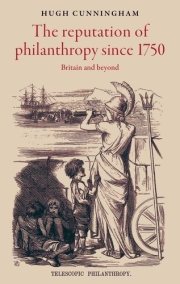
Editors’ Note: Benjamin Soskis reviews The Reputation of Philanthropy Since 1750 Britain and Beyond, by Hugh Cunningham. Hugh Cunningham’s new book, The Reputation of Philanthropy Since 1750 Britain and Beyond, helps to explain two conundrums related to discussions of contemporary philanthropy. The first is why, when referring to a philanthropist, do most people instantly imagine … Continue reading
A Small Grant Can Go a Long Way: Building Support for Native American Governance
Editors’ Note: Michael Lipsky tells the story of a small Ford Foundation grant, made by Norm Collins in 1986, that led to the Harvard Project on American Indian Economic Development at Harvard’s Kennedy School of Government and paved the way for Ford’s Honoring Contributions in the Governance of American Indian Nations awards program. This post … Continue reading
Capital and Ideology…and Philanthropy
Editors’ Note: Andrew Hart reviews Thomas Piketty’s Capital and Ideology, with a particular focus on what the book might (or might not) tell us about the relationship between philanthropy and inequality. French economist Thomas Piketty’s latest book, Capital and Ideology (Capital et idéologie, 2019), arrived in English in mid-March, when people with office jobs were … Continue reading
Rethinking Results: The Development of Outcome Evaluation in U.S. Social Work
Editors’ Note: Maoz Brown details the history of outcome evaluation in the human services, summarizing an argument he recently made in the December 2019 issue of Social Service Review. The entire issue, on social work history, is worthy of attention from historians of philanthropy. It contains, for instance, important contributions on the Russell Sage Foundation-funded … Continue reading
The Gentleness of Charity: British Sectoral Policy in the COVID-19 Crisis
Editors’ Note: John Picton examines the politics behind the British government’s (disappointing) emergency funding package directed to the nation’s charities. The COVID-19 health crisis has led to a funding crisis in the British charity sector. Face-to-face fundraising is impossible, charities have had to close their shops, and the value of investment and reserve funds is … Continue reading
Political Theory and the Nonprofit Sector
Editors’ Note: Ted Lechterman and Rob Reich introduce their chapter on political theory in the third edition of The Nonprofit Sector: A Research Handbook (Stanford University Press). For other posts in HistPhil‘s forum on the Research Handbook, see here. Many scholars study what nonprofits do, by describing, analyzing, or predicting their behavior and performance. Fewer … Continue reading
Private Giving, Public Sector Failure, and the Covid-19 Crisis
Editors’ Note: Sarah Reckhow introduces her chapter on “Politics, Philanthropy, and Inequality” in the newly published third edition of The Nonprofit Sector: A Research Handbook, and ties it to the charitable response to the Covid-19 crisis. For other posts in HistPhil‘s book forum on the Research Handbook, see here. The COVID-19 pandemic crisis has tested … Continue reading
Philanthropy in a time of crisis: Lessons from European History
Editors’ Note: Rhodri Davies looks to the history of philanthropy’s responses to epidemics and other crises in Europe over the last five centuries for insights on the themes that might help us understand how it is likely to do so today. Those working in civil society may feel as though they don’t have the luxury … Continue reading
The Outcomes Movement in Philanthropy and the Nonprofit Sector
Editors’ Note: Paul Brest introduces his chapter in the newly published third edition of the Nonprofit Sector: A Research Handbook, on outcome-oriented philanthropy. For other posts in Histphil‘s forum on the Handbook, see here. Introduction: The Essence of Outcome-Oriented Philanthropy My chapter in the Nonprofit Sector: A Research Handbook chronicles the rise of the contemporary … Continue reading
Nonprofits and the City
Editors’ Note: Claire Dunning and Christof Brandtner introduce their chapter in the new 3rd edition of The Nonprofit Sector: A Research Handbook (Stanford University Press, 2020). Read posts from other contributors to the Handbook, including an introduction to this forum, here. Look around any city block, and chances are you’ll see a nonprofit organization. The … Continue reading
Seeing Like a Philanthropist: An organizational sociology of philanthropic history
Editors’ Note: Aaron Horvath and Walter Powell introduce their chapter in the third edition of the Nonprofit Sector: A Research Handbook (Stanford University Press, 2020), edited by Powell and Patricia Bromley. The Handbook, first published in 1987 and then revised in 2006, has long served as an important resource for the sector. But this edition … Continue reading
The Power and Precedent of Countercyclical Grantmaking: What the Funders Who Gave More During the Great Recession Can Teach Philanthropy During the Covid-19 Crisis
Editors’ Note: Ryan Schlegel takes a look back at grantmaking during the Great Recession and reflects on what lessons it might hold for funders confronting the economic crisis unleashed by the Covid-19 pandemic. For more on HistPhil‘s coverage of the Covid-19 crisis, see here. The first quarter of 2020 was one of the all-time worst … Continue reading
Getting From Giving, and The “Good Glow” Of Charity
Editors’ Note: Jon Dean introduces his forthcoming book, The Good Glow: Charity and the Symbolic Power of Doing Good (May 2020). Starting with the basic premise that people tend to think positively of other people whom they perceive to be altruistic and kind, Dean argues that such seemingly charitable people are imbued with a certain … Continue reading
Power, Ignorance and the New Philanthropic Enlightenment
Editors’ Note: An early critic of philanthrocapitalism and the Gates Foundation – arguing in No Such Thing as a Free Gift: The Gates Foundation and the Price of Philanthropy (2015) that in the age of philanthrocapitalism “[g]iving more” had become “an avenue for getting more” – Linsey McGoey introduces her newest book, The Unknowers: How Strategic … Continue reading
It’s Not Torah From Sinai: Historicizing the 5% Payout Orthodoxy in the midst of the Covid-19 Crisis
Editors’ Note: HistPhil co-editor Benjamin Soskis argues that the Covid-19 crisis is a moment to challenge the 5% payout orthodoxy by appreciating its historical contingency. For HistPhil’s other posts on the crisis, see here. Over the last decade, as the public has confronted a steady stream of crises—economic, political, ecological—advocates have steadily called on foundations … Continue reading
Mutual aid and physical distancing are not new for Black and racialized minorities in the Americas
Editors’ Note: Caroline Shenaz Hossein responds to Lucy Bernholz’s recent blog post predicting shifting philanthropic trends– a “rebirth of mutual aid”– during the COVID-19 pandemic. Hossein argues that “any general trends towards mutual aid in the U.S. should be understood, not simply or principally as a return to earlier giving habits, but also as an … Continue reading